
UK Pound slips slightly against Pakistani Rupee
- By Fahad Ali -
- Jun 01, 2026


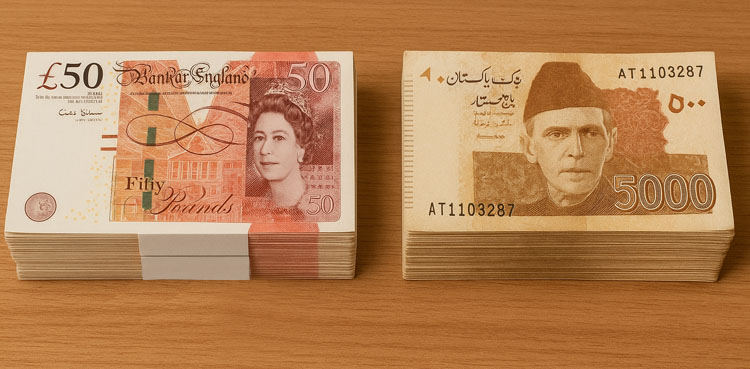
The UK Pound (GBP) has dipped slightly against the Pakistani Rupee (PKR) in the open market after Eid al-Adha holidays.
Despite this minor downward tick, the Pound continues to exhibit strong global performance, sustained by high investor confidence and a cautious monetary approach by the Bank of England (BoE).
Meanwhile, the Pakistani Rupee remains under pressure due to domestic inflationary concerns, upcoming external debt repayments, and a tight benchmark policy rate maintained at 10.50% by the State Bank of Pakistan (SBP).
Weekend vs. Week-Open Market Dynamics
The Pakistani Rupee gained minor ground over the weekend, slightly cooling off from the previous week’s closing rates.
On Saturday, May 30, 2026, the UK Pound wrapped up the month holding steady at an average buying rate of Rs. 374.08 and a selling rate of Rs. 379.10 against the Pakistani Rupee.
By Monday, June 1, 2026, the open market numbers adjusted slightly downward, with the UK Pound buying rate settling at Rs. 372.98 and the selling rate landing at Rs. 378.10, marking a modest drop of roughly one Rupee for market participants.
Contrasting Central Bank Trajectories
The ongoing movement of the UK Pound to the Pakistani rupee pair reflects two entirely different economic environments.
The UK Pound retains its position as a highly resilient global asset. Experts point to the United Kingdom’s steady macroeconomic indicators and a widespread belief that the Bank of England will remain highly disciplined with its monetary policy. This steady baseline keeps global investor interest high.
On the other side of the equation, the State Bank of Pakistan is working to protect the Pakistani Rupee against multiple compounding headwinds.
The Pakistani Rupee’s stability is heavily dependent on hitting key milestones in Pakistan’s IMF program, managing high import demands, and preserving foreign exchange reserves. To balance the aggressive push of domestic inflation against basic economic growth needs, the SBP has chosen to hold its primary interest rate steady at 10.50%.
The Two-Sided Reality: Commercial Strain vs. Remittance Gains
This exchange rate climate directly impacts both corporate bottom lines and everyday household budgets in distinct ways.
Increased Pressures on Imports and Higher Education
Pakistani businesses relying on British goods, such as medical supplies and specialized machinery, are absorbing much higher operational expenses. For instance, settling a routine £10,000 commercial invoice now demands nearly Rs. 3.79 million out of pocket.
This financial weight extends to families sending students to the UK. With typical British tuition and living overheads running between £15,000 and £25,000 annually, even minor shifts in the exchange rate can alter a family’s educational budget by hundreds of thousands of Pakistani Rupees. Consequently, corporate treasuries are turning more frequently to authorized currency hedging mechanisms to lock in costs.
A Boost for Families Supported by Overseas Workers
On the flip side, the UK Pound’s elevated value is a major win for Pakistani expats living in Britain. Under current market conditions, sending home just £100 yields roughly Rs. 37,843 for local families. This added value directly elevates the spending power of these households, which supports local businesses and injects critical foreign liquidity into the broader national economy.
Near-Term Forecast and Trading Advice
Market analysts foresee a stable to modestly bullish path for the UK Pound to the Pakistani rupee pair in the weeks ahead. While technical indicators suggest the UK Pound still has upward momentum on the global stage, traders should watch for upcoming UK economic reports and BoE press conferences, which often spark quick bouts of volatility.
For Pakistan, the path forward hangs heavily on boosting exports, maintaining high remittance numbers, and securing steady foreign investments.
Trading Insight:
Forex specialists strongly suggest that individuals and corporations execute all currency transactions solely through licensed banks and SBP-approved financial institutions. They also note that market liquidity and price fluctuations hit their peak during the afternoon hours when the Karachi and London trading sessions overlap.
Disclaimer: Exchange rates shift rapidly throughout the day and frequently differ among individual banks, retail booths, and corporate exchange platforms.