
Antarctica dinosaur fossil identified as rare titanosaur after 40 years
- By Web Desk -
- Jul 01, 2026


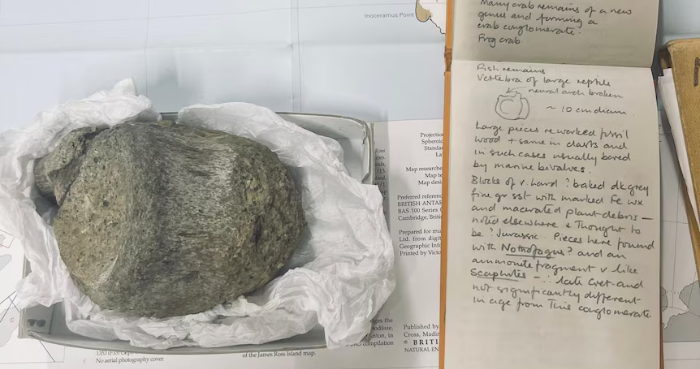
In a significant scientific breakthrough, a fossilized bone found in Antarctica nearly 40 years ago has been confirmed to belong to a massive titanosaur. This historic find is the first dinosaur bone ever discovered on the icy continent.
In December 1985, geologist Dr. Mike Thomson discovered a 10-centimeter-wide bone while studying marine rock layers on the Antarctic Peninsula. He documented it in his field diary as a “vertebra of a large reptile’ and sent the specimen to the British Antarctic Survey (BAS) geology collection in England.
The historic bone was hidden inside a drawer and remained unidentified for nearly 40 years until BAS collections manager Dr. Mark Evans examined it more closely. Drawing on his expertise in vertebrate paleontology, Evans identified its unique shape and correctly guessed it was a tail vertebra from a titanosaur.
Titanosaurs were among the largest land dinosaurs, with some species exceeding 35 meters in length and weighing up to 15 tonnes. Nonetheless, researchers believe this particular bone belonged to a smaller juvenile titanosaur, measuring roughly six to seven meters long.
The fossil was extracted from a marine rock layer dating back 82 million years. During that era, Antarctica was a warm, temperate, heavily forested region. Scientists suspect the young dinosaur died near a coast or river, and its carcass floated out into a shallow seaway before sinking and fossilizing on the seabed.
Professor Paul Barrett, a researcher at the Natural History Museum in London, noted that the discovery provides crucial insights into how dinosaurs spread across southern continents.
READ MORE: When will humans go extinct? New study estimates timeline for humanity’s end
Because there is currently limited evidence of titanosaur fossils in New Zealand and none in Australia, confirming their presence in Antarctica suggests the animals traveled across these historically connected landmasses.
Finding dinosaur remains in Antarctica is extremely rare because of the continent’s vast ice cover. Associate Professor Steven Salisbury of the University of Queensland noted that only about a dozen dinosaur fossils have been found in the region to date.
“The reality is down there you are really searching for a needle in a haystack,” Salisbury explained. He noted that finding terrestrial fossils in marine rock requires incredible luck, as the carcass must avoid heavy scavenging and settle perfectly at the bottom of the seaway.
Although the fossil itself is small, Salisbury emphasized its historical significance. He explained that this discovery not only confirms the presence of dinosaurs in Antarctica’s timeline but also fills a crucial gap in the very limited fossil record.