
Mir Raza Ali Case: The Questions That Won’t Go Away
- By Noman Awan -
- Aug 11, 2026


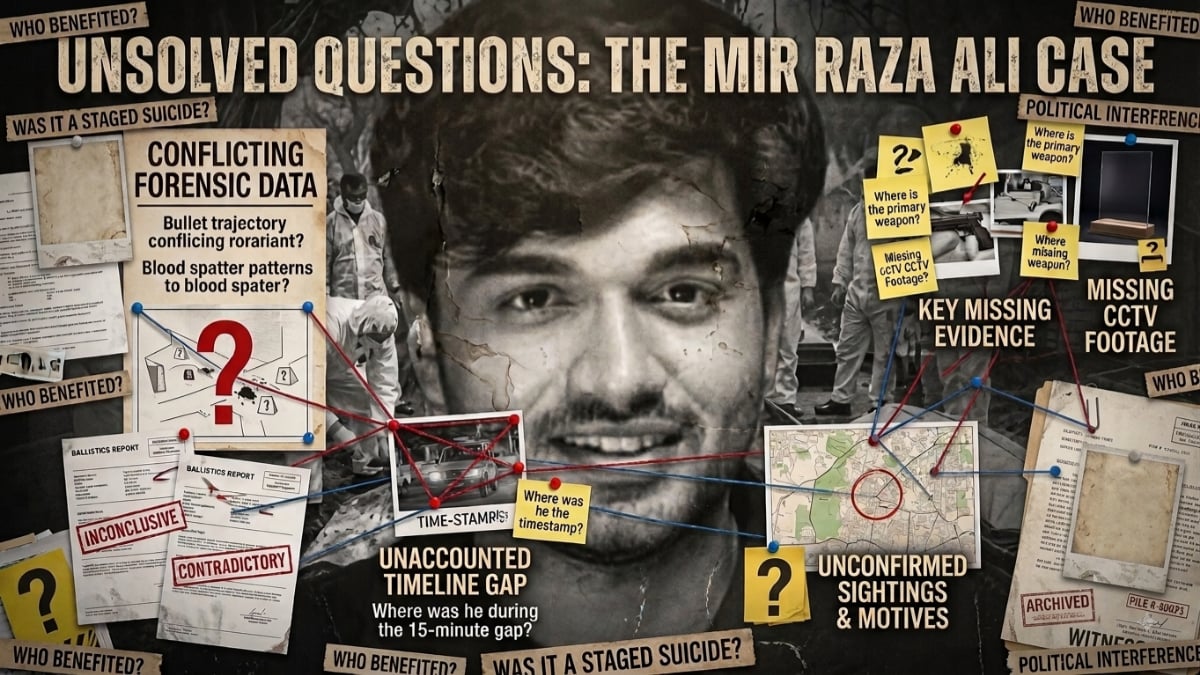
The death of 25-year-old Karachi entrepreneur Mir Raza Ali has become the subject of a growing investigation, with conflicting post-mortem findings, questions over the initial police response and a family demanding answers about what happened to him.
Mir Raza Ali, an Institute of Business Administration (IBA) graduate and businessman, disappeared from PECHS, Karachi on the night of 28 July 2026. His family says he left after telling them he would be back within 10 minutes.
His body was found two days later on 29 July 2026 in bushes in the Nursery area of Gulistan-e-Jauhar, near Shahi Qila.
What initially appeared to be a case of abduction and death has since developed into a dispute over the circumstances of his killing, and over the conduct of those responsible for investigating and examining his body.
An FIR, a disappearance and a desperate search:
The First Information Report (FIR No. 795/2026) was initially registered at Ferozabad Police Station on 28 July on a charge relating to abduction/disappearance. Mir Raza Ali’s father, Mir Hussain, lodged it.
According to the family, they had already contacted the police emergency helpline and continued searching for him through the night.
His father later described the search to the media, saying:
“I lodged an FIR under Section 365 at Ferozabad Police Station between about 3:30 and 4 am. Before that, I had called the police 15 emergency helpline.”
The family also reviewed CCTV footage in an attempt to trace Ali’s movements.
The following morning, 29 July 2026, his father contacted Bykea, the online ride service and parcel delivery company, to obtain details of the location associated with his son’s journey. He said the location was around 200 metres from the kitchen of the deceased’s outlet.
What happened next, according to the father of deceased Mir Ali Raza, has become one of the most troubling parts of the case.
The Guest House Mystery:
The family went to the location and, according to Mir Hussain, the father of Mir Raza Ali, security guards told them there was nobody there but pointed towards two allegedly illegal guest houses nearby run by some influentials.
Mir Hussain said that while the family was standing outside one of the guest houses, they showed Mir Raza Ali, the victim’s photograph, to a man who immediately ran away. Two other men who also came out of the guest house allegedly did the same.
“We were standing in front of the guest house when a man came towards us. My wife showed him our son’s photograph and asked him about him. As soon as he saw the photograph, he ran away. Then two more men came; they also saw the photograph and ran away. They escaped by jumping from the rear roof,” Mir Hussain said.
The father then said that several men arrived on motorcycles and asked the family why they were there. He explained that his son was missing.
According to his account, he was subsequently told that three men had jumped into an office from behind.
Mir Hussain said he was later asked by a bungalow guard to move his family away from the area.
The father of Mir Raza Ali further said he eventually caught two of the men and brought them back to the guest house. When the premises were opened, he said, his son was not there, although a child was found in one of the locked rooms.
He said he was looking at CCTV footage from the guest house when police arrived, telling the family that the guest-house management had complained.
Then came a discovery that transformed the case. Police told the family that a body had been found.
The father said the body was discovered at about 11:20 am, while the family was at the guest house at around 12:45 pm.
That sequence of events has left the family asking a series of unanswered questions:
Who were the men who ran away? Why did they flee? Who owned or operated the guest house?
What was its connection, if any, to the place where Mir Ali’s body was found?
Read Also: Mir Raza Ali case: Forensic report finds sedative in blood samples
Who Owns the Guest House?
On that stage, the identity of the owner of the guest house had not been conclusively established in the material available for this account.
The family’s account does, however, raise an important investigative question: Were the guest-house premises, their occupants, staff or CCTV recordings properly investigated by police?
The account also raises questions about the three men who allegedly fled after seeing Ali’s photograph.
Whether they were witnesses, people connected to the guest house, or had any connection with the disappearance is a matter that investigators would need to establish through evidence.
The reported presence of an allegedly unregistered or illegal guest house makes the issue particularly significant.
The First Post-mortem:
Mir Ali’s body was examined on 29 July 2026 by Dr Osama Sheikh, a medico-legal officer at Jinnah Postgraduate Medical Centre (JPMC), according to the first post-mortem report.
The report described a single firearm injury to the chest.
According to the police surgeon’s subsequent account, the examination found no evidence that the body had been burned with fire or acid.
The body was, however, showing signs of decomposition. The first report attributed death to hemorrhagic shock caused by severe blood loss.
Police investigators also said the victim had apparently been shot with a .30-bore pistol. At that stage, however, the weapon and spent cartridge had reportedly not been recovered.
For the family, the first examination raised more questions than answers.
Mir Raza Ali’s father, Mir Hussain, rejected the possibility that his son had taken his own life and argued that the injuries were inconsistent with suicide.
A Second Examination Changes the Picture:
The controversy intensified after the body was exhumed and a second post-mortem was conducted.
The second report, issued on 8 August,2026 came 12 days after Mir Raza Ali’s death and 11 days after the first post-mortem, and its findings were markedly different.
Rather than describing a bullet wound entering the chest, the second examination reported that the bullet had entered through the upper left back, at the level of the sixth rib, and travelled through the body before exiting through the front.
The entry wound was reported to be approximately 0.8cm long.
The examination also recorded injuries, bruising, blood clotting and fractures in different parts of the body. A fracture was reported at the back of the skull, while two injuries were reported on the heart.
The body had reached an advanced stage of decomposition, making identification of some features difficult.
Importantly, the second report did not give a final opinion on the precise cause of death pending the receipt of relevant reports.
The difference between the two examinations is at the center of the current controversy.
Why Did Police Surgeon, Dr Summaiya Syed, Intervene?
Dr Summaiya Syed Tariq, Karachi’s police surgeon and head of medico-legal services, subsequently raised concerns about the first examination.
In a letter to SSP East Zubair Nazeer Sheikh, on 3 August 2026, after 4 days of the first autopsy, she reportedly identified 14 alleged shortcomings in the first post-mortem and recommended that the body be re-examined.
Among the questions raised was whether all the necessary forensic procedures had been performed during the original examination.
The timing and circumstances of Dr Summaiya Syed’s intervention have themselves generated questions.
Why, critics ask, did she communicate her concerns through a letter to a senior police officer rather than take direct administrative action against the medico-legal officer responsible for the original report?
Why did she raise objections after such a long period of 4 days? What restrained her from doing so?
Was she present when the original autopsy was conducted?
If not, what were the reasons for her absence?
And was the original report dispatched without her reviewing and signing it?
These are questions about institutional procedure which should be answered.
A Police Surgeon, Dr Summaiya Syed, Says She Feels “helpless”
The controversy deepened on 7 August 2026 when Dr Summaiya Syed posted a message on X, formerly Twitter.
She wrote:
“In all of my 4 years as head of Medicolegal Services in Karachi/Police Surgeon, I have never felt this helpless. My quest for truth and justice has often encountered impediments, but this time, it is asphyxiating. Tired. Too tired.”
She later said the post reflected her personal feelings.
The post was deleted at around 7:52 pm.
That raised another question: What pressures or obstacles was the senior medico-legal official referring to?
Dr Summaiya Syed did not publicly identify those alleged impediments in the post.
Her comments’ timing inevitably drew attention because they came amid the controversy surrounding his post-mortem.
Another unusual feature of the case is that Dr Summaiya Syed subsequently remained involved in the medical board responsible for the exhumation and second examination.
The Claims About Post-mortem Practice:
The controversy has also prompted wider claims about medico-legal practice in Pakistan.
Senior crime journalist A.H. Khanzada, who has worked as a crime reporter for more than three decades, described what he said was a longstanding problem in the conduct of post-mortems.
He says: “Occasionally, post-mortems are not properly conducted. Instead, a hospital sweeper makes an incision from the throat downwards and then stitches it up so that it appears a post-mortem was conducted, while the medico-legal officer prepares the report without actually carrying out the examination.”
Senior journalist A.H. Khanzada also explained the procedure that is normally followed when a person is found dead. According to Khanzada, when a deceased person is brought to a hospital, the medico-legal officer informs the police control room and the relevant police station. The police station then formally requests that the cause of death be determined through a post-mortem examination.
Referring specifically to the Mir Raza Ali case, Khanzada said the first post-mortem itself should now be subjected to scrutiny to determine whether any procedural lapse occurred.
He argued that if shortcomings were found in the first examination, responsibility would also have to be examined at the supervisory level.
He pointed to the role of Additional Police Surgeon Dr Summaiya Syed Tariq, who, according to him, was holding the additional charge of Police Surgeon at the time.
Khanzada questioned why any objections or concerns regarding the first post-mortem were not addressed internally within the medico-legal department at the outset.
In his view, the supervising police surgeon should have sought an explanation from the medico-legal officer concerned and raised any objections within the department, which could potentially have resolved the matter before it escalated into a wider controversy.
A former police officer, SSP Niaz Ahmed Khosa, was quoted as supporting concerns about the functioning of medico-legal examinations, while crime reporter Saqib Sagheer also alleged that post-mortem reports were sometimes prepared after doctors examined photographs of bodies kept at the Sohrab Goth Edhi morgue.
These are serious allegations about the wider medico-legal system. They are not, by themselves, proof that the first post-mortem of Mir Raza Ali was fabricated or that Dr Osama did not examine the body.
The difference between the first and second reports, however, has made those broader questions more prominent.
Inspector General of Police (IGP) says the case has been solved:
Surprisingly, despite all these controversies and alarming questions, on 6 August 2026 Sindh Inspector General of Police Javed Alam Odho claimed that Karachi police had solved the case.
Speaking to journalists during a visit to the Karachi Bar Association, he said investigators had extensively worked on the case and that there had been no negligence.
“The entire case has been traced,” he said, adding that police would soon hold a press conference to disclose the details.
At the same time, the police chief acknowledged that there was “some confusion” surrounding the case.
He said an “unrelated medico-legal officer” had made comments about the matter while the medico-legal documents contained different findings.
Here is another important question: on what grounds and why did the IGP Javed Alam Odho confidently and unequivocally claim that the case has been cracked?
Several Critical Questions Remain To Solve:
1: Who abducted or encountered Mir Raza Ali after he left his home?
2: Who were the men who allegedly fled when shown his photograph outside the guest house?
3: What do its CCTV recordings show?
4: Where exactly was Mir Raza Ali shot?
5: Can the recovered 30-bore casing be matched to the firearm and the projectile that killed him?
6: Why do the first and second post-mortem examinations differ so substantially on the location and trajectory of the gunshot wound?
And finally, was the first post-mortem properly conducted and documented?
Those questions cannot be answered by the conflicting reports alone.
They require the forensic evidence, including ballistic analysis, CCTV footage and witness statements, to be examined alongside the medical findings.
A case now caught between two versions of death
The first post-mortem described a young man who had suffered a gunshot wound to the chest and died from hemorrhagic shock.
The second examination described a bullet entering from the upper left back and travelling through the body, while documenting additional injuries and fractures and reserving a final opinion on the cause of death.
The police say the wider investigation has been traced and that the apparent contradictions can be resolved through the medical board and forensic evidence.
Mir Raza Ali’s family, meanwhile, says the central issue is simpler: their son left home expecting to return within minutes and ended up dead.
The guest house, the men who allegedly fled, the CCTV footage, the recovered cartridge and the two very different medical examinations are now pieces of the same puzzle.
Until those pieces are independently reconciled, the circumstances surrounding Mir Raza Ali’s death remain contested.
And the most important question, how exactly did he die, and who was responsible? remains one that the investigation must answer with evidence rather than assumption.
New Investigation Team Formed:
Amid growing pressure from the media and civil society groups, following the controversies surrounding the case, Karachi police have formed a new team to investigate the case of Mir Raza Ali.
DIG Crime and Investigation, Amir Farooqi, heads the new investigation team, while SP RRF, Syed Mohammad Ali Raza, is the secretary of the team.
According to the notification, SP Investigation Korangi, Qais Khan, and SP Investigation Central, Anam Tajamul, have also been included in the new investigation team, while SIO Zaman Town, Inspector Chaudhry Ghazanfar, has also been made part of the team.
The notification directs the investigation team to conduct a comprehensive, transparent and impartial investigation into the case. The newly constituted team will collect and preserve all new and additional evidence.
The team will examine physical, technical, circumstantial and forensic evidence related to the case. It will also submit its report to the relevant court within the stipulated period.
The investigation team has further been directed to submit daily progress reports and bring the case to its logical conclusion by investigating all aspects thoroughly.
Disclaimer: The views expressed here are solely the author’s and do not necessarily reflect the opinions and beliefs of ARY News or its management.