
Missile fired from Yemen as Israel and US target Iran
- By Reuters -
- Mar 28, 2026


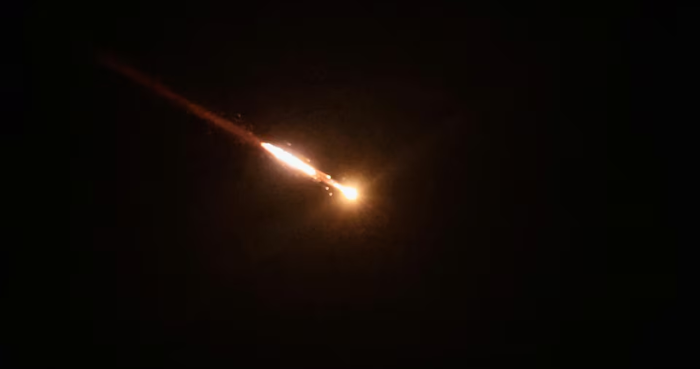
CAIRO: Israel said on Saturday it had detected a missile fired from Yemen, the first since the Iran war began, while Secretary of State Marco Rubio said the U.S. expected to conclude military operations within weeks, not months.
A month after the U.S. and Israel launched strikes on Iran, the conflict has spread across the Middle East, killing thousands and causing the biggest disruption ever to energy supplies, hitting the global economy and fuelling inflation fears.
While Israel said it was again hitting targets across Iran’s capital on Saturday, it identified what it said was a missile launched from Yemen.
RISK OF BROADENING WAR
Hours earlier, Yemen’s Houthis said they were prepared to act if what the group called an escalation against Iran and the “axis of resistance” continued, but did not say what form any intervention would take.
Houthi involvement in the war would risk broadening the conflict, given their ability to strike targets far beyond Yemen and disrupt shipping lanes around the Arabian Peninsula and the Red Sea, which they had done in support of Hamas in Gaza after October 7, 2023.
Rubio told reporters after meeting Group of Seven counterparts in France that Washington was “on or ahead of schedule in that operation, and expect to conclude it at the appropriate time here – a matter of weeks, not months”.
The war has driven a wedge between the U.S. and its traditional allies, who have stayed on the sidelines. President Donald Trump said this lack of support had implications for NATO, the West’s most important alliance.
“We would have always been there for them, but now, based on their actions, I guess we don’t have to be, do we?” Trump told an investment forum in Miami on Friday. “Why would we be there for them if they’re not there for us? They weren’t there for us.”
The charter underlying the North Atlantic Treaty Organization (NATO), which has long been led by the U.S., says an attack on one member is an attack on all, requiring them to support each other.
Rubio said European and Asian countries that benefit from trade through the Strait of Hormuz, a vital choke point largely blocked by Iran, should contribute to efforts to secure free passage.
While he said the U.S. could achieve its aims without ground troops, he acknowledged it was deploying some to the region “to give the president maximum optionality and maximum opportunity to adjust the contingencies, should they emerge”.
Washington has dispatched two contingents of thousands of Marines to the region, the first of which is due to arrive in coming days on a huge amphibious assault ship. The Pentagon is also expected to deploy thousands of elite airborne soldiers.
The deployments have raised concerns that the war could turn into a prolonged ground battle.
MORE STRIKES WHILE TRUMP SPEAKS OF NEGOTIATIONS
Stock markets tumbled sharply on Friday while the Brent crude oil benchmark topped $112, having risen more than 50% since the war began.
In the U.S., where Trump is politically vulnerable to rising fuel prices, diesel in California hit a record average high of $7.17 a gallon, the American Automobile Association said.
Trump has appeared eager to wind down the unpopular war, emphasizing this week what he called productive negotiations aimed at a diplomatic solution – despite repeated assertions from Tehran that no such talks have begun. On Thursday, Trump extended a deadline by 10 days for Iran to reopen the Strait of Hormuz or face attacks against its civilian energy grid.
While those strikes were on hold, missiles and drones continued to rain down across the region.
An Iranian attack on an air base in Saudi Arabia wounded 12 U.S. military personnel, two seriously, a U.S. official told Reuters on Friday, as drones and missiles continued to strike around the Gulf.
Israel’s military said on Saturday it had detected incoming missiles from Iran, and Syrian state television reported explosions heard above the capital Damascus from Israeli intercepts of the Iranian missiles.
The United Arab Emirates (UAE) and Bahrain also reported missile attacks early on Saturday, with five people injured and fires reported after a missile was intercepted near Abu Dhabi’s KEZAD economic zone.
At least five people were killed and seven injured after a U.S.-Israeli attack on a residential unit in Iran’s northwestern city of Zanjan, Iranian media reported early on Saturday. The Iran University of Science and Technology in Tehran was also struck, media reported.
Iranian Foreign Minister Abbas Araqchi said on X that Israel, in coordination with the U.S., had also hit two steel factories and a power plant. “Attack contradicts POTUS extended deadline for diplomacy. Iran will exact HEAVY price for Israeli crimes,” Araqchi said on Friday, using an acronym for president of the United States.