
Traders reject early market closure policy
- By Web Desk -
- Apr 07, 2026


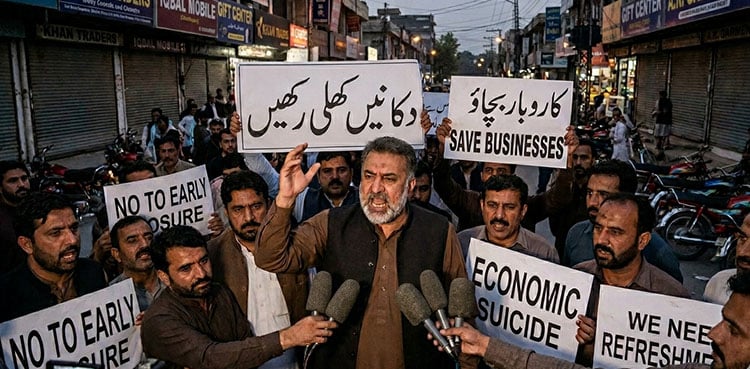
ISLAMABAD: The President of the All Pakistan Anjuman-e-Tajiran (APAT), Ajmal Baloch, has strongly opposed the government’s decision to enforce early market closures, stating that traders across the country will not shut shops before 10pm, ARY News reported.
Baloch urged Prime Minister Shehbaz Sharif to review the decision to close markets early, warning that the move would create serious difficulties for the business community in Pakistan. He emphasized that shutting shops at 8pm was “unacceptable” and impractical.
According to Baloch, traders are already purchasing the most expensive electricity between 6pm and 10pm, and forcing businesses to close during peak hours would worsen financial pressures. He added that the trader community plays a vital role in sustaining Pakistan’s energy needs and overall economy.
He further claimed that the governments of Sindh and Khyber Pakhtunkhwa are willing to consider traders’ concerns, while calling on federal authorities as well as the governments of Punjab and Balochistan to withdraw the decision.
Also Read: New Market, Restaurant Timings Announced for Punjab, KP and Balochistan
Baloch warned that early closures would lead to overcrowding in limited hours, making it difficult to manage customer flow. He argued that austerity cannot be achieved by shutting down businesses, but rather by cutting government perks and adopting simplicity.
Highlighting the fragile economic situation, he pointed out that several state institutions, including Pakistan Steel Mills, Pakistan International Airlines, and Pakistan Railways, are already facing billions in losses.
The traders’ leader called on the ministers of commerce and energy to immediately hold talks with the business community, stressing that dialogue is essential. “If mediation is possible between countries like the US and Iran, why can’t the government talk to traders?” he questioned.
He warned that any strict action against traders could lead to a countrywide protest movement.