
What lies behind the Eye of the Sahara formation? NASA explains
- By Asim Mallick -
- Apr 28, 2026


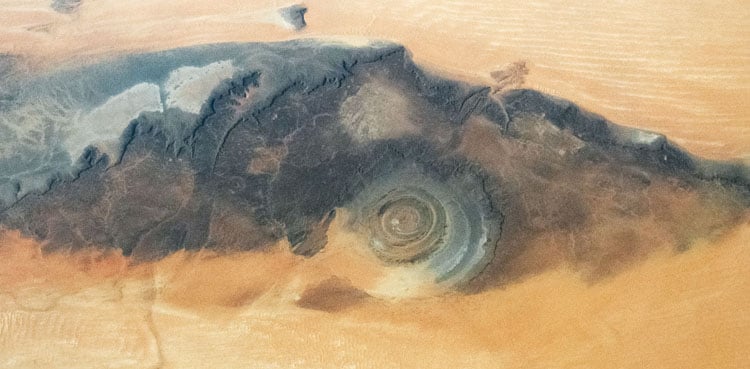
Observations by NASA from the International Space Station have once again drawn attention to one of the most striking natural formations in the Sahara desert—the massive Richat Structure, often called the “Eye of the Sahara.”
From orbit, the formation appears almost unreal, a near-perfect circular pattern stamped into the Sahara desert, something that for years led many to assume it was the result of a meteor impact.
But the latest interpretation shared through NASA Earth Observatory leans firmly in another direction. The so-called eye, it turns out, is the result of a geological uplift—essentially a dome of rock slowly exposed and carved out by erosion over time.
The structure stretches roughly 25 miles across, though measurements can vary slightly depending on how the boundaries are drawn.
Also Read: Ancient Greek philosopher’s missing text discovered in Cairo archives
That variation, honestly, isn’t unusual in terrain this vast. What remains consistent is its visibility. In the middle of the Sahara desert, where the landscape can feel almost featureless from above, the formation stands out sharply, making it a familiar reference point for astronauts passing overhead.
The science behind it is less dramatic than a meteor strike but, in a way, more telling. Layers of rock were pushed upward, forming a dome, and over time, wind and erosion shaped those layers into rings.
In the Sahara desert, where wind is a constant force, softer rock wore away faster, leaving behind ridges that now define the structure’s appearance.
Surrounding dunes add another layer to the story. Patterns in the sand reflect shifting wind directions across the Sahara desert, forming long linear ridges in some areas and broader wave-like shapes in others. It’s not static; the landscape keeps adjusting, quietly but continuously.
What makes this observation matter goes beyond geology. The same winds shaping the Sahara desert also carry vast amounts of dust across continents, influencing weather, ecosystems, and even ocean life far from Africa.
From space, those connections become easier to see, even if, on the ground, they are harder to grasp all at once.