
Taiwan opposition leader pledges reconciliation at memorial for founding father in China
- By Reuters -
- Apr 08, 2026


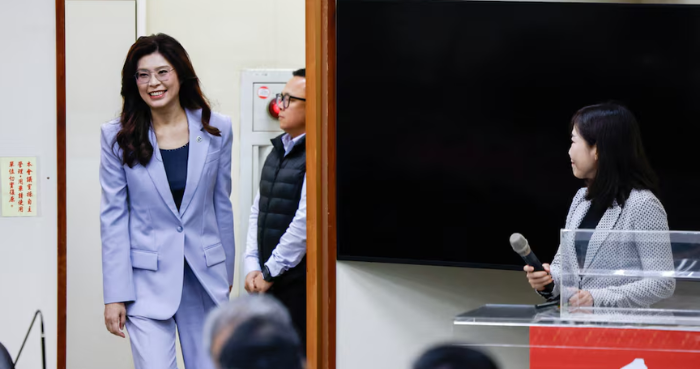
NANJING: Taiwan opposition leader Cheng Li-wun pledged on Wednesday to channel the spirit of her party’s founder, Sun Yat-sen and seek reconciliation with China, offering praise at his tomb for the country’s achievements following the communist revolution.
Cheng, chairwoman of the Kuomintang (KMT), Taiwan’s largest opposition party, is in China at a time of increased Chinese military pressure on Taiwan, which Beijing views as its own territory, and as the opposition-dominated parliament stalls a government plan for $40 billion in extra defence spending.
In a moment filled with symbolism on her first full day in the country, Cheng laid a wreath at Sun’s mausoleum in the eastern city of Nanjing, also the capital of the KMT-led Republic of China government before it fled to Taiwan in 1949 having lost a civil war with Mao Zedong’s communists.
“The core values of Sun Yat-sen’s ideal that ‘all under heaven are equal’ have always been equality, inclusiveness, and unity,” Cheng said, in footage carried live on Taiwanese television channels.
“We should work together to promote reconciliation and unity across the (Taiwan) Strait and create regional prosperity and peace.”
FOUNDER OF REPUBLIC OF CHINA
Sun, who overthrew the last imperial dynasty and founded the Republic of China in 1912, died of cancer in 1925.
He is still officially venerated in Taiwan as the founder of the Republic of China, but also in China by the Communist Party as a Chinese national hero. Mao declared him the “great revolutionary forerunner”.
Cheng said the KMT had eventually honoured Sun’s founding principles and made Taiwan into a free and democratic society, though she also mentioned the “white terror” of the 38 years of martial law the island lived under until 1987.
“Likewise, on the mainland, we have also seen and witnessed progress and development that exceeded everyone’s expectations and imagination,” she added.
While Taiwan is a multi-party democracy, China’s communist party brooks no dissent to its rule.
Security was tight for her visit.
“I think this is very important for peaceful exchanges between the two sides of the Taiwan Strait,” said student Yang Zihang, 19, who came with his classmate to see Cheng’s motorcade.
China refuses to speak to Taiwan President Lai Ching-te, saying he is a “separatist”. Lai says only Taiwan’s people can decide their future.
Neither government formally recognises the other.
Cheng says she is on a mission of peace, and that while she supports defence spending, it has to be balanced with dialogue.
TAIWAN OFFICIALS WARY
Wu Cheng, a spokesperson for Taiwan’s ruling Democratic Progressive Party, said if the KMT really wanted stability across the strait, it should stop blocking defence spending in parliament.
“Peace has never come from the charity of dictators; it must be safeguarded by Taiwan’s own strength,” he said in a statement.
Lai’s government has said Cheng should also tell Chinese officials, including President Xi Jinping should she meet him, to stop China’s regular military harassment of the island and respect the Taiwanese people’s right to choose their own future.
Speaking to reporters at parliament in Taipei earlier on Wednesday, Taiwan National Security Bureau Director-General Tsai Ming-yen said he couldn’t comment on what political parties do, but added China uses a carrot-and-stick approach.
China uses military intimidation and harassment to create an atmosphere of rising military danger and instability across the Taiwan Strait, he said.
“This is intended to make Taiwan’s society and public feel the psychological pressure and anxiety of a possible conflict,” Tsai added.
“It aims to divide Taiwanese society internally, boosting the visibility of pro-China positions. It can also further obstruct efforts to push forward U.S. arms procurement deals.”