
U.S senators urge trump to negotiate as government shutdown looms
- By Reuters -
- Sep 21, 2025


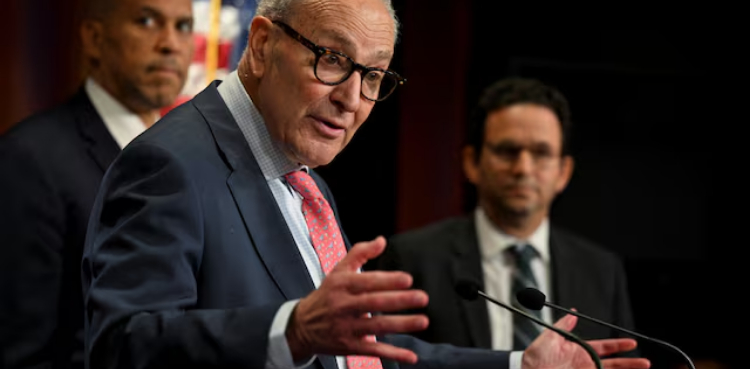
U.S. Senate Democratic Leader Chuck Schumer and his counterpart in the House of Representatives, Hakeem Jeffries, on Saturday demanded a meeting with President Donald Trump to avoid a government shutdown when funding ends on September 30.
In a letter addressed to Trump, Schumer and Jeffries said Republican congressional leaders had repeatedly and publicly refused to engage in bipartisan negotiations to keep the government open at the direction of the president.
Healthcare is at the center of the fight over funding, with Democrats seeking more money for subsidies under the Affordable Care Act and the restoration of funding cut from the Medicaid healthcare program for lower-income Americans.
“Democrats have been clear and consistent in our position. We are ready to work toward a bipartisan spending agreement that improves the lives of American families and addresses the Republican healthcare crisis,” Schumer and Jeffries wrote.
“However, we will not support a dirty spending bill that continues the Republican assault on healthcare.”
The Senate on Friday rejected a short-term funding bill and then left town for a week-long break, increasing the odds of a shutdown.
Congress has struggled to pass spending legislation in recent years due to rising partisan tensions, repeatedly raising the threat of a shutdown that would leave government workers unpaid and a wide range of services disrupted.
“With the September 30th deadline fast approaching, Republicans will bear responsibility for another painful government shutdown because of the refusal of GOP congressional leadership to even talk with Democrats,” the two leaders wrote.
“As a result, it is now your obligation to meet with us directly to reach an agreement to keep the government open and address the Republican healthcare crisis.”
On the other hand, US President Donald Trump on Saturday ordered an annual $100,000 fee be added to H-1B skilled worker visas, creating potentially major repercussions for the tech industry where such permits are prolific.
The new measure, which could likely face legal challenges, was announced alongside the introduction of a $1 million “gold card” residency program that Trump had previewed months earlier.
“The main thing is, we’re going to have great people coming in, and they’re going to be paying,” Trump told reporters as he signed the orders in the Oval Office.
What is H-1B skilled worker visa
H-1B visas allow companies to sponsor foreign workers with specialized skills — such as scientists, engineers, and computer programmers — to work in the United States, initially for three years, but extendable to six years.
Indians to be most affected
The United States awards 85,000 H-1B visas per year on a lottery system, with India accounting for around three-quarters of the recipients.
Large technology firms rely on Indian workers who either relocate to the United States or come and go between the two countries.
Tech entrepreneurs — including Trump’s former ally Elon Musk — have warned against targeting H-1B visas, saying that the United States does not have enough homegrown talent to fill important tech sector job vacancies.
“All the big companies are on board,” said Commerce Secretary Howard Lutnick, who joined Trump in the Oval Office.
Trump has had the H-1B program in his sights since his first term in office, but faced court challenges to his earlier approach, which targeted the types of jobs that qualify. The current iteration has become the latest move in the major immigration crackdown of his second term.
Read More: Trump sees progress on TikTok, says will visit China
According to Trump’s order, the fee will be required for those seeking to enter the country beginning Sunday, with the Homeland Security secretary able to exempt individuals, entire companies, or entire industries.
The order expires in a year, though Trump can extend it.
The number of H-1B visa applications has risen sharply in recent years, with a peak in approvals in 2022 under Democratic president Joe Biden.
In contrast, the peak in rejections was recorded in 2018, during Trump’s first term in the White House.
The United States approved approximately 400,000 H-1B visas in 2024, two-thirds of which were renewals.
Trump also signed an order creating a new expedited pathway to US residency for people who pay $1 million, or for corporate sponsors to pay $2 million.
“I think it’s going to be tremendously successful,” Trump added.